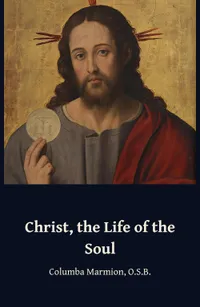
Christ, the Life of the Soul
Book Summary
Christ, the Life of the Soul is a series of spiritual conferences by Columba Marmion, Abbot of Maredsous, on the place of Jesus Christ in the Christian life. Its single governing idea is that holiness consists in sharing, by grace, the divine sonship of Christ: God wills to make us his adopted children, and does so only in and through his Son. "Christ is not one of the means of spiritual life," Marmion writes; "He is all our spiritual life." The first part, "The Economy of the Divine Designs," sets out God's plan and Christ's role in it. The second, "Foundation and Double Aspect of the Christian Life," shows how the soul receives that life through faith and Baptism and lives it out as "death to sin" and "life for God." The edition opens with a letter of Pope Benedict XV and prefaces by Cardinals Mercier and Bourne.
The Divine Plan in Christ
The opening conference takes its text from Ephesians: God chose us in Christ "before the foundation of the world" and predestined us "unto the adoption of children." Marmion warns against souls who invent their own idea of holiness, or who lose themselves in details without a view of the whole. God is a Father who eternally begets a Son, and he extends this paternity to creatures: "By nature God has only one Son; by love, He wills to have an innumerable multitude." The plan, broken by Adam's sin, is restored by the Incarnation. The next three conferences, following St. Thomas, describe Christ's mediation. He is the one Model of all perfection, so that the Christian is alter Christus, "another Christ." He is the satisfactory and meritorious cause of our salvation, since only a God made man could make full satisfaction for sin. And he is the efficient cause of grace, his humanity acting as the instrument of the Word through the sacraments and through the "spiritual contact" of faith.
The Church and the Holy Spirit
Two conferences complete the first part. The Church is first a visible, hierarchical society holding Christ's doctrine, sacraments and worship, and Marmion insists that "no one goes to Christ except through the Church." God's choice to sanctify us through weak human ministers is "a prolongation, an extension of the Incarnation" that also exercises our faith. More deeply, the Church is Christ's mystical body, and Marmion cites St. Augustine's teaching that the whole Christ is head and body together. The conference on the Holy Spirit treats his procession in the Trinity, his work in the soul of Christ, and his role as the soul of the Church. It ends with his gifts and the duty of docility: habitual resistance to his inspirations leaves the soul at a "mediocre level of holiness."
Faith, Baptism and Death to Sin
The second part opens with faith in the divinity of Christ, which Marmion calls the foundation of the inner life and a source of joy. Baptism, the "sacrament of adoption and initiation," reproduces in the soul the death and resurrection of Christ, and the whole Christian life is presented as the development of this double grace. Under "Death to Sin," Delicta Quis Intelligit? treats mortal sin as practical contempt for God and the destruction of grace, warns against venial sin, and counsels watchfulness, prayer and confidence in Christ against temptation. The conference on penance explains contrition, confession (a homage to the humanity of Christ) and satisfaction. It then presents the virtue of penance as lifelong self-denial that draws its value from union with Christ crucified.
Life for God: Charity, Sacrament and Prayer
Under "Life for God," Marmion gives the law of supernatural activity in St. Paul's phrase "doing the truth in charity." Our actions must be true to our nature, our personality and our state of life ("In order to act as Christians, we must first of all act as men"), and done in grace and charity. A conference on growth in Christ follows, covering the theological virtues, the primacy of charity, and the moral virtues as "love's safeguards." Marmion then turns to the sources of this life. The Mass renews Calvary, offering adoration, propitiation, thanksgiving and petition, and Communion is the "Bread of Life," with counsels on preparation and thanksgiving. Vox Sponsae presents the liturgy and psalmody as the voice of the Bride. The conference on prayer defines it as "the intercourse or conversation of a child of God with his Heavenly Father." Citing St. Benedict, St. Ignatius, St. Teresa and St. Francis de Sales, it insists: "Method is one thing, prayer another."
Charity, Mary and the Heavenly Inheritance
"Love One Another" grounds fraternal charity in Christ's new commandment at the Last Supper and in the unity of the mystical body, from which no one can separate himself without being separated from Christ. "The Mother of the Incarnate Word" explains Mary's place through her Fiat, her share in Christ's mysteries, and the words from the Cross, "Behold thy mother," by which she becomes our mother in grace. The final conference, Coheredes Christi, describes the inheritance of God's children: to see, love and enjoy God, with the body sharing that glory after the resurrection. Because "glory is only the unfolding of grace," Marmion stresses that the degree of eternal beatitude is fixed by the degree of charity reached at death.