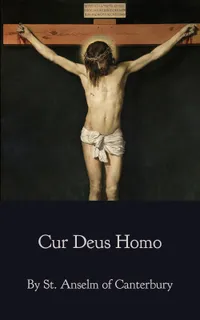
Cur Deus Homo
Book Summary
Anselm's "Cur Deus Homo" (Why God Became Man) is a theological work that uses philosophical reasoning to explain the necessity of the Incarnation and Crucifixion of Christ for human salvation. Structured as a dialogue between Anselm and a questioning monk named Boso, the book develops the "satisfaction theory" of atonement. Anselm argues that human sin constitutes an infinite offense against God's honor, creating a debt that humanity is obligated to pay but incapable of satisfying. He concludes that only a being who is both fully God (to have the ability to pay the infinite debt) and fully man (to have the obligation to pay it on behalf of humanity) could bridge this gap. This God-man, Jesus Christ, by willingly offering his infinitely valuable life, makes perfect satisfaction to God, thus restoring God's honor and making it possible for God to be both just and merciful in forgiving sinners.
The Problem of Sin and the Necessity of Satisfaction
The first part of the book establishes the core problem that requires divine intervention. Boso, representing both believers and unbelievers, questions why an omnipotent God could not simply forgive humanity by an act of will, rather than undergoing the humiliation and suffering of becoming human. Anselm counters that sin is not merely a transgression but an act that robs God of the honor He is due from His creation. For God to simply forgive this debt without payment would be to leave sin unpunished, creating disorder in His kingdom and treating the guilty the same as the righteous, which would be inconsistent with His perfect justice. Anselm argues that every sin, no matter how small, is an infinite offense because it is committed against an infinite God. Therefore, the satisfaction required to restore God's honor must be greater than the entire created universe. He concludes that humanity is trapped: they owe a debt they cannot possibly pay, and God's justice prevents Him from simply ignoring it.
The God-Man as the Only Solution
Having demonstrated that satisfaction for sin is both necessary and humanly impossible, Anselm presents the logical necessity for the God-man. He reasons that since only man ought to pay the debt but only God can pay it, the one who pays must be both God and man. This leads to the requirement of a unique being: perfect God and perfect man united in one person. This God-man must be taken from the race of Adam to properly represent humanity, yet must be without sin himself, as a sinner cannot atone for others. Anselm explains that this is achieved through the virgin birth, where Christ takes on human nature from a sinful lineage but is conceived without original sin. As a sinless being, this God-man does not owe the debt of death. His mortality is not a punishment but a voluntary condition he assumes, giving him the unique ability to offer his life freely.
The Atonement and Its Application
In the final section, Anselm explains how the death of the God-man accomplishes salvation. Because Christ is sinless, his death is not a debt he owes. By willingly choosing to lay down his life—an act of perfect obedience and a gift of infinite value—he offers a satisfaction to God that far outweighs all the sins of humanity. Since Christ, as God, is perfect and in need of no reward, the immense merit generated by his sacrifice can be applied to others. He bestows this merit upon those for whom he died, covering their debt of sin. This allows God to forgive humanity without compromising His justice; the debt is not ignored but paid in full. This framework explains how God can be both perfectly just, in that sin is punished, and perfectly merciful, in that sinners who place their faith in Christ's work are forgiven and reconciled to Him.