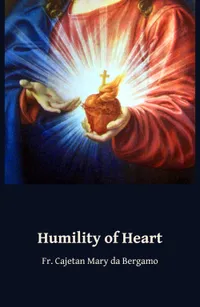
Humility of Heart
Book Summary
Humility of Heart is a treatise by Fr. Cajetan Mary da Bergamo, an eighteenth-century Italian Capuchin missionary, on the one virtue he holds that no Christian can be saved without. It opens with a sentence that sets the tone for everything after it: there are saints in Paradise who never gave alms, never fasted, and were not virgins, "But in Paradise there is no Saint who was not humble." Cajetan defines humility as truth, a right knowledge of God's greatness and of one's own nothingness, and treats pride as the root of every sin. The book has three parts: a hundred numbered "Thoughts and Sentiments on Humility," a practical examen of conscience, and a closing "Moral Doctrine" on the vice of pride. This edition is Cardinal Vaughan's English translation, with a preface by Bernard Vaughan, S.J., and the Cardinal's own introduction, which recommends using the book as a meditation book for years at a time.
Humility as Truth
The early Thoughts argue that humility is a matter of precept and not only of counsel. Christ called everyone into His school to learn one lesson, "Learn of Me, because I am meek and humble of heart," and did not ask all His followers to work miracles or preach. Cajetan grounds humility in plain facts about the self: the body ends in the grave, the conscience holds the memory of sin, and every person is capable of any evil if God withdraws His grace. Since a person has nothing of his own except his nothingness, the proud man is "like a thief, appropriating to myself that which is not mine but God's." Humility, he says, has two eyes, one that sees one's own misery and one that refers everything good to God. He distinguishes being humiliated from being humble, and warns that thinking oneself humble is already the beginning of pride. Pride lies behind every fall into sin, and God sometimes allows the proud to fall into impurity so that the shame will cure them: "No one can fall who lies on the ground; and no one can sin so long as he is humble."
Motives and Means
The later Thoughts gather reasons for humility and ways to practise it. Cajetan turns to death, judgment, hell and eternity, asking the reader to meet every offer of honour with the question "And then? And then?", and to the uncertainty of predestination, which he says God left hidden so that "between hope and fear we might remain humble." He names patience under insult as "the proof of true humility," and counts those who humiliate us as instruments of our salvation, to be thanked like a surgeon. Prayer is best when it is most humble, and distractions should be swept away like flies, which "do not fly round boiling water, but only round tepid water." He borrows St. Francis's nightly meditation, "Who art Thou? and who am I?", and compares a person proud of his gifts to a beast of burden boasting of the gold or relics it happens to carry. The Thoughts close with Christ, the King of the humble, from the stable to the Cross, and with the Virgin Mary as their Queen. In heaven, Cajetan says, all other virtues cease and only charity and humility remain.
The Practical Examen
The second part turns these thoughts into a daily examination. Cajetan advises working on only one or two of one's worst faults at a time, renewing resolutions from day to day, and confessing these faults. The examen follows the three objects of humility. Toward God, it asks about humility in prayer, confession, Holy Communion, belief in the mysteries of faith, and adversity, and it traces scruples back to pride. Toward one's neighbour, it covers superiors, equals and inferiors, and warns against a false humility that gives up a duty of authority out of cowardice. It separates a "humility of knowledge," which holds oneself inferior to everyone, from a "humility of affection," which is glad to be thought so by others. Toward oneself, it examines daydreams of honour, self-praise, the habit of speaking ill of oneself so that others will contradict it, and vanity in dress.
The Vice of Pride
The closing "Moral Doctrine" studies pride directly, following St. Thomas and St. Gregory. Pride is defined as "an inordinate affection against right reason, by which man esteems himself and desires to be esteemed by others above that which he really is." Cajetan lists seven reasons why it is the most dangerous vice: it destroys every virtue, it slips into good works, it wins the moment we rejoice at having beaten it, it is the first vice learned and the last to leave, it blocks grace, it marks the reprobate, and it hides behind the look of virtue. He then describes four ways of sinning by pride, with Nabuchodonosor, Lucifer, the Bishop of Laodicea and the Pharisee as examples, and eight vices born from it: presumption, ambition, envy, vainglory, boastfulness, hypocrisy, disobedience and discord. The book ends with St. Gregory's judgment that pride is the surest sign of the reprobate, as humility is the sign of the elect.