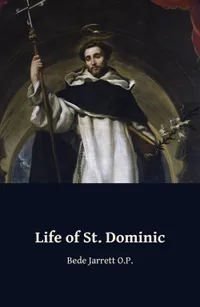
Life of St. Dominic
Book Summary
Life of St. Dominic is Bede Jarrett's biography of the Spanish canon who founded the Order of Friars Preachers. Drawing chiefly on the sworn depositions of the 1233 Process of Canonisation, Jarrett traces Dominic from his boyhood in Castile through ten years of preaching against the Albigensian heresy in Languedoc to his death at Bologna in 1221. He argues that Dominic created the first religious Order in the modern sense: a single body spread across Christendom, devoted to preaching the truths of the faith, grounded in study, and governed by election. The opening chapters tell the story in order; the middle chapters examine his preaching, prayer and constitution; the last turn to his companions, his character and his death.
From Calaruega to Languedoc
Jarrett begins with Dominic's birth at Calaruega to Felix de Guzman and Joan of Aza, and his mother's dream of a dog bearing a burning torch that set the world aflame. At Palencia the young student sells his annotated books to give the money in charity, saying, "I could not bear to prize dead skins when living skins were starving and in want." He then spends quiet years as a canon of the reformed chapter of Osma under Diego d'Azevedo. In 1203 he goes with Diego, now his bishop, on a royal marriage embassy that passes through Toulouse, where Dominic argues all night with a heretical innkeeper and reconciles him to the Church by morning. Jarrett describes the dualist creed of the Albigensians, for whom matter is evil, and explains why the richly equipped Cistercian legates were failing against the austere "Perfect." When Diego persuades them to preach on foot and in poverty, Dominic "was no longer called Subprior but Brother Dominic." There follow public disputations and the ordeal in which Dominic's written defence of the faith is thrown three times into the fire and comes out unharmed, and the crusade of his friend Simon de Montfort.
Prouille and the Founding of the Order
On the feast of St Mary Magdalen in 1206, Dominic sees a globe of fire come down over the ruined church of Prouille on three evenings in a row. Having seen that the heresy spread through mothers, women's houses and schools, he gathers nine converted noblewomen there in a cloistered convent that is at once a centre of prayer, a school and a refuge, joined to his preachers in a "double monastery." Jarrett later follows the nuns to St Sisto in Rome and to Madrid. He rejects the idea that Dominic founded the Inquisition as "an historical fallacy." He then recounts the gift of a first house in Toulouse by Peter Seila, the Fourth Lateran Council's ban on new religious rules, and the brethren's choice of the Rule of St Augustine in 1216. Honorius III confirms the Order in a series of bulls, calling its friars "the champions of the faith and the true lights of the world." After his return from Rome with the bulls, Dominic scatters his sixteen friars, most of them to Paris and Spain, saying, "We must sow the seed, not hoard it."
Preaching, Prayer and Government
Untrained lay preachers such as the Waldensians and Humiliati had fallen into error, so laymen were limited to exhorting "penance," but Dominic meant his friars to expound doctrine itself and "overset science by science." His friars therefore go straight to the universities, to Paris, where they become the "Jacobins," and to Bologna, which Reginald of Orleans sets "in flames." To keep scholars from growing dry, Dominic gives them the choral Office, fasting, silence and poverty: "in order to drive them into the world he drove them from it." Yet he would sooner cut up every copy of the Constitutions with his knife than let the rule bind under sin. Jarrett describes Dominic praying aloud and with gestures through the night, his devotion to the crucifix as "the book of the crucified," and his part in spreading the rosary. A chapter on the Constitutions shows how Dominic adapted the statutes of Prémontré into a system of elected priors, provincials and Master General, with chapters that must pass a law three times before it binds. "Democracy may mar results," Jarrett concludes, "but it makes men."
Companions, Portrait and Death
Jarrett sketches Dominic's first followers: William Claret, John of Navarre, his brother Mannes, and the brilliant Reginald, healed by a vision of Our Lady in which he is shown the white scapular. Among them is Jordan of Saxony, a shy Paris student who succeeds Dominic as Master. The chapter on Dominic's portrait sets the panel painting at San Domenico Maggiore in Naples beside Sister Cecilia's description of a fair-haired man of middle height with a "radiance" on his brow, and gathers witnesses to his iron-chain disciplines, his nights in church, his refusal of three bishoprics, and his joy. The final chapter follows Dominic's fever in the Bologna summer of 1221, his deathbed bequest of charity, humility and voluntary poverty, and his promise, "I am going where I can serve you better." He dies on August 6 in another friar's bed and tunic and is buried "under the feet of the brethren." The book closes with the translation of his relics, the canonisation bull of his friend Gregory IX, and later Dominicans such as Savonarola, Las Casas and Lacordaire, for whom his Order stood for truth and freedom.