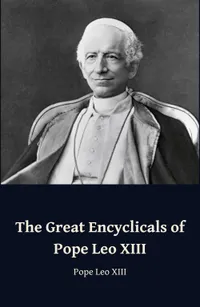
The Great Encyclicals of Pope Leo XIII
Book Summary
The Great Encyclicals of Pope Leo XIII collects thirty encyclicals, apostolic letters and constitutions issued by Leo XIII between 1878 and 1902. Arranged roughly by date, they range from treatises on the state, liberty and labor to letters addressed to France, England, the United States and the Philippines. A recurring conviction runs through them all: that the evils of modern society come from setting aside the authority of the Church, and that religion is the chief source of true civilization and progress. A short preface presents them as Leo's teaching on "the chief questions of a time."
The Church and Modern Society
The collection opens with Inscrutabili, which lists the evils oppressing the human race and traces them to contempt for the Church, which Leo calls the "nurse," "mistress" and "mother" of civilization. Quod Apostolici Muneris condemns socialism, communism and nihilism, and Humanum Genus sets the Freemasons within Augustine's picture of two cities formed by two loves and asks the bishops "to tear away the mask from Freemasonry." Immortale Dei describes the Church as a perfect society, distinct from the civil power but meant to live in concord with it. Libertas Praestantissimum defines liberty by the eternal law and examines the modern liberties of worship, speech and teaching, allowing that public authority may tolerate evil to avoid a greater one but never approve it. Sapientiae Christianae sets out the duties of Catholics as citizens. Au Milieu des Sollicitudes urges French Catholics to put aside political quarrels and accept the republic as the actual government of their country. Later pieces defend the religious congregations in France, reorganize the Church in the Philippines, and, in the Review of His Pontificate, look back over the "implacable war that is waged against the Church" since the Reformation.
Marriage, Property and Labor
Arcanum defends the unity and indissolubility of Christian marriage as a sacrament, and argues that divorce, once tolerated, cannot be kept within bounds. Rerum Novarum takes up "The Condition of the Working Classes." Leo rejects the socialist remedy and defends private ownership as a natural right. Against the notion that class is naturally hostile to class, he insists that "Capital cannot do without Labor, nor Labor without Capital." He sets out the duties of employers and workmen; the State must not absorb the individual or the family, yet must protect the poor. He teaches that wages "ought to be sufficient to support a frugal and well-behaved wage-earner," defends Sunday rest, and calls workingmen's unions the most important of all associations. A decade later Graves de Communi distinguishes Christian Democracy from Social Democracy, defining it as "a benevolent and Christian movement in behalf of the people," one free of political parties that respects property and the distinctions of class.
Philosophy, Scripture and the Censorship of Books
Aeterni Patris surveys the use of philosophy from the apologists and Fathers to the medieval universities where "Thomas reigned supreme." It ends by asking the bishops "to restore the golden wisdom of St. Thomas" in their schools. Providentissimus Deus defends the inspiration of Scripture, criticizes the "higher criticism," which judges each book "from internal indications alone," and gives Augustine's rule for apparent conflicts with science. Vigilantiae follows up by establishing the Biblical Commission in Rome. The apostolic constitution Officiorum ac Munerum traces the Church's condemnation of harmful books from the early popes to the Index of Paul IV and the Council of Trent, and is printed with its General Decrees, which cover vernacular Bibles, permission to read forbidden works, and the books that must go to the censors.
The Unity of the Church
Several letters of the mid-1890s concern the reunion of Christians. Praeclara Gratulationis appeals first to the Eastern Churches, which Leo says are not far removed from Rome, and then to the nations separated from Rome for three centuries. The letter to the English People recalls Gregory the Great's mission to the Anglo-Saxons and closes with a prayer to Mary for England, "thy 'Dowry.'" Satis Cognitum argues that Christ gave his Church a visible unity of faith and government founded on Peter and the keys. Apostolicae Curae reviews the history of the Edwardine Ordinal and declares Anglican ordinations "absolutely null and utterly void." Of two letters to the United States, Longinque Oceani praises the growth of the American Church, while Testem Benevolentiae, prompted by the controversy over the life of Isaac Hecker, rejects the opinions grouped under the name "Americanism," such as the division of the virtues into "passive" and "active," because they suggest "a church in America different from that which is in the rest of the world."
Christ, the Holy Spirit and the Eucharist
The devotional letters turn to the interior life. Exeunte Iam Anno, written at the close of Leo's priestly jubilee, calls all Christians to conform their lives to Christ through mortification and prayer. Divinum Illud treats the Holy Spirit in the Incarnation, in the Church, and in his "indwelling" in the souls of the just. Annum Sacrum consecrates the human race to the Sacred Heart. Tametsi declares that "Christ our Lord must be reinstated as the Ruler of human society," since the people have heard enough of the "rights of man" and should now "hear of the rights of God." Mirae Caritatis completes the series by presenting the Eucharist as "the very soul of the Church" and urging that frequent Communion be revived everywhere.