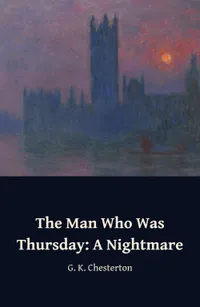
The Man Who Was Thursday: A Nightmare
Book Summary
The Man Who Was Thursday, subtitled A Nightmare, is G. K. Chesterton's novel about Gabriel Syme, a poet turned police detective who gets himself elected to the seven-man Central Anarchist Council, whose members are named after the days of the week. Its vast president, Sunday, and a run of unmaskings turn the spy story into something stranger. The story runs through fifteen chapters in four movements: Syme's election in London, the exposure of the Council one member at a time, a flight across northern France, and a chase after Sunday that ends in a garden masquerade and a vision. A dedicatory poem to Edmund Clerihew Bentley calls the book "a tale of those old fears, even of those emptied hells" that troubled the two friends in their youth.
The Poet of Law
The novel opens in the artistic suburb of Saffron Park, where the red-haired poet Lucian Gregory preaches that "an artist is identical with an anarchist." A newcomer, the mild-looking Gabriel Syme, calls himself a poet of law and order and argues that a train arriving at Victoria is more poetic than chaos. Stung by Syme's doubt that he is serious, Gregory makes him promise not to tell the police and leads him to an underground chamber hung with bombs. Gregory expects the London branch to elect him that night to the vacant post of Thursday. Syme then reveals his own secret: he is a Scotland Yard detective, bound by his oath just as Gregory is bound by his. At the meeting Syme denounces Gregory's mild speech as fit for a curate and is elected Thursday in his place. A chapter of flashback tells how a philosophical policeman on the Embankment recruited Syme into a corps of "policemen who are also philosophers," enlisted in a pitch-dark room by an unseen chief who told him, "I am condemning you to death."
The Unmasking of the Council
At the Council's breakfast on a hotel balcony in Leicester Square, Syme meets Monday, the Secretary, with his lopsided smile; Tuesday, the shaggy Pole Gogol; Wednesday, the Marquis de St. Eustache; Friday, the decrepit Professor de Worms; and Saturday, Dr. Bull, whose black spectacles hide his eyes. They are planning to kill the Czar and the French President in Paris. Sunday announces that there is a spy among them and names Gogol, who pulls off his wig to reveal a red-haired cockney detective. The paralytic Professor then dogs Syme through snowbound London before revealing that he too is a policeman: a young actor named Wilks, who once impersonated the real philosopher so well that the anarchists threw the original out. The two work out a finger-tapping code and confront Dr. Bull in his garret. When Syme asks him to remove his spectacles, Bull turns out to be a cheerful, boyish young man, also from the police.
The Earth in Anarchy
The three detectives cross to France, where Syme provokes the Marquis into a duel timed so that he will miss the Paris train. Syme's sword passes through him again and again without drawing blood. Syme takes his opponent for the Devil and reflects that a man can do "the one thing which Satan himself cannot do—I can die." Then the Marquis asks to have his nose pulled; it comes off, revealing Inspector Ratcliffe of the police, convinced that Sunday has seized the world and that the Secretary has just stepped off the train with a masked mob. With the French Colonel Ducroix they flee by cart, horse and motor-car, while a peasant, a kindly innkeeper, the wealthy Dr. Renard, the gendarmes and finally Ducroix himself all seem to join the pursuit. Cornered on a pier at Lancy, Syme strikes down the Colonel with an old iron lantern carved with a cross and hurls it into the sea. Then the Secretary unmasks and tries to arrest them in the name of the law. Every member of the Council except Sunday was a detective, and the mob were ordinary townspeople hunting anarchists.
Sunday and the Seven Days
The six detectives return to Leicester Square to ask Sunday what it all means. He tells them they are "a set of highly well-intentioned young jackasses," declares "I am the man in the dark room, who made you all policemen," and leaps from the balcony. They chase him by cab, fire-engine, a runaway elephant from the Zoo and a balloon from Earl's Court, while he pelts them with nonsense notes. Trudging after the balloon, each man describes Sunday differently, and Syme suggests that "we have only known the back of the world." Servants then bring the six to a country house where they are robed as the days of Creation and seated on thrones beside Sunday. Asked who he is, Sunday answers, "I am the Sabbath," and "I am the peace of God." The Secretary protests, "I cannot forgive Him His peace." Gregory then appears as the one real anarchist and curses them "for being safe." Syme answers that they too have been broken and have the right to say, "We also have suffered." When he turns to ask Sunday whether he has ever suffered, he hears, "Can ye drink of the cup that I drink of?" Syme then finds himself walking with Gregory near Saffron Park at dawn, where Gregory's sister is cutting lilac.