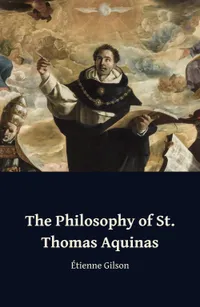
The Philosophy of St. Thomas Aquinas
Book Summary
The Philosophy of St. Thomas Aquinas is Étienne Gilson's systematic exposition of the philosophy contained in the works of Aquinas, offered, in the words of his preface, as "no more than a first guide" to the Summa theologica. Gilson's central claim is that St. Thomas, faced with the newly translated Aristotle, neither rejected him with the Augustinians nor followed him wholesale with the Averroists, but set out "to Christianise Aristotle," building a philosophy that rests on reason alone yet agrees with faith. Because Aquinas never wrote a separate philosophical summa, Gilson follows the order of the two Summae, moving from God to creation, from the angels to man, and from human knowing and willing to man's last end. Throughout, he sets St. Thomas's positions against those of St. Bonaventure, St. Anselm, Avicenna and Averroës.
The Thomistic Problem: Faith and Reason
Gilson opens with the life and works of St. Thomas, from his oblature at Montecassino and his years under Albertus Magnus to his death at Fossanuova in 1274. He then describes the crisis that defined his task: Aristotle's physics and metaphysics, read through Averroës, seemed to teach an eternal world, a single intellect for all men and no personal immortality. In St. Thomas's answer, some truths about God, such as His existence, can be demonstrated, while others exceed reason and must be believed, and since both come from God they cannot conflict. Philosophy and theology remain formally distinct, differing in their principles of proof and in their order, the one rising from creatures to God and the other descending from God to creatures. "Faith and Reason can neither contradict each other, nor ignore each other, nor be confused," Gilson concludes, and on this ground he calls St. Thomas "the first, and not the least, of modern philosophers."
The Existence and Nature of God
St. Thomas first rejects the claims that God's existence is self-evident, including innate knowledge of God and St. Anselm's argument, because all our knowledge begins in the senses and God must be known from His effects. Gilson then works through the five ways in both their Summa theologica and Summa contra Gentiles forms. The proof from motion, which St. Thomas held the most evident, receives a full chapter. The proofs from efficient cause, from the possible and the necessary, from the degrees of being and from the government of things follow, with a long discussion of the disputed fourth proof and its Platonic sources. The divine attributes are then reached in two ways: by negation, which shows God to be eternal, simple and outside every genus, and by analogy, which applies goodness, unity, infinity, intelligence and will to God neither univocally nor equivocally.
Creation and the Hierarchy of Beings
Creation is the production of being from nothing, an act proper to God alone and performed freely through the ideas that exist in Him as exemplars. On the beginning of the world, Gilson places St. Thomas between the Averroists and the Augustinians: neither the eternity nor the non-eternity of the world can be demonstrated, and its beginning in time is held by faith. The inequality of creatures comes from God's intention to express His perfection in many degrees, while evil is a privation with no positive being and no cause in God. A full chapter treats the angels, a subject Gilson thinks historians wrongly neglect. They are pure forms without matter, each its own species, knowing through innate intelligible species and ranked in three hierarchies of three orders, so that the universe forms a continuous order from God down to matter.
Man: Soul, Knowledge and Will
The human soul stands "on the confines" of spirits and bodies, the lowest of intelligences and the highest of material forms. Against Plato's soul as a pilot in his ship and against a plurality of forms, St. Thomas makes the intellectual soul the single form of the body, so that it is the whole man who knows. Gilson describes the vegetative and sensitive powers, including the common sense, imagination, estimative power and memory. In rational knowledge the active intellect abstracts the intelligible from the phantasm supplied by the senses, and because our intellect is made to draw the intelligible from the sensible, it knows God and the angels only imperfectly. The will necessarily desires the good in general but remains free toward every particular good.
The Moral Life and the Spirit of Thomism
The last chapters follow man's return to God. Gilson analyses the human act through intention, deliberation, consent and choice, and treats habit as the dynamic element by which a person grows toward or away from his end. He sets out the intellectual virtues and the cardinal virtues of prudence, justice, temperance and fortitude, defining moral good as conformity with reason. Happiness lies in no created good but only in the vision of God's essence, which cannot be reached in this life. The concluding chapter insists that "the man of St. Thomas is the man not of Plotinus, but of Aristotle," and compares his philosophy with his prayers and hymns such as the Pange lingua, finding in his teaching "above all Christianity."